Hello! It is now 2016 and this semester, my blog will be
exploring 21st century literacies and how different types of
literacies can be used in the classroom.
The way literacy is viewed has changed. Literacy is more
than reading, writing, and speaking. The world is rapidly changing, creating a
need to make sense of these changes and prepare future generations to become
successful in our society.
There are new aspects of education that have changed and are
different from the way things were when I was in elementary school, which
emphasizes the importance of being aware of various issues, both new and
reoccurring, that affect students and education. For example, the use of
technology in classrooms is becoming more important in the 21st
century. Not only do teachers assist students in learning how to use various
technologies in the classroom (i.e. google, smart boards), but teachers must
also teach students how to use the technology appropriately to facilitate their
learning as well as promote critical thinking skills to examine and make sense
of the content. The view of literacy has changed in the 21st century
context. New literacies allow educators to move beyond the “traditional” ways students
have been taught towards more innovative ways to teach and address the
diversity of students’ learning needs and interests.
As a future educator, I will be expected to have an
understanding of the new literacies (such as those included in the image) and
how they can be integrated into my teaching in a 21st century
context, while upholding the curriculum expectations. I have much to learn and
I am excited to learn about the multiple literacies and what each entail to
prepare to be a teacher in the future!
Peer- and Self-assessment (PASA) can provide huge
benefits in helping students achieve! Peer-assessment
is when students to provide each other with valuable feedback so they can learn
from and support each other (Swain, 2010). It provides the opportunity to
discuss, listen, explain, and challenge each other. Self-assessment is when students form judgments about their own
work. It promotes independent learning and helps students take responsibility
for their learning progress.Here is a great video of self-assessment implemented in a Grade 2 classroom:
These types of assessments cannot be used for grades and
Ontario actually prohibits it! The assessment
information is used by students to improve their learning (Drake, Reid, &
Kolohon, 2014). For PASA to be effective, students need to be explicitly taught
about assessment. Like teachers, students need to become assessment literate! Students must have a clear understanding of the
expectations and criteria of assessments. This can be done by breaking down
rubrics into language that is easy to understand or even creating rubrics together
with students! I remember receiving rubrics in elementary school for many assignments and projects. However, I often did not understand what the terms meant or how to use it, making it meaningless for me!
In addition, students need to know the characteristics of
different levels of quality work and know what it looks like. One way to
demonstrate this to students is by applying rubrics to examples of different
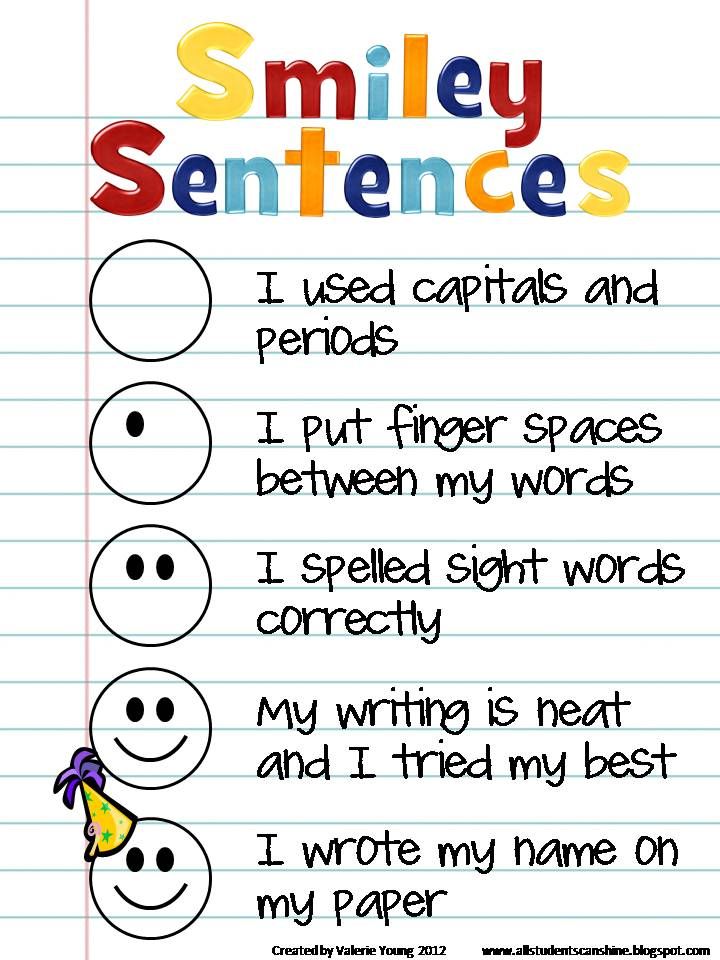
levels of work. In my Grade 1 classroom at my placement, there was a visual
with ice-cream sundaes that had various amounts of scoops of ice cream and
toppings (similar to the "Smiley Sentences" picture) to demonstrate
the characteristics of level 1 to 4 work, such as using grammar, capital
letters to begin sentences, finger spaces, and punctuation. It was great to see the student refer back to it when working on their writing tasks.
Teachers must also teach students how to give appropriate
feedback to their peers, such as teaching them sentence starters like “I was
confused when…” and “I liked it when you…”. For PASA to be successful, students need to view
mistakes as an opportunity for learning (aka have a growth mindset) and be
encouraged to engage in honest reflection. Teach Primary provides some great sentence starters!
There are several benefits of PASA (Drake et al., 2014; Harris
& Brown, 2013; Swain, 2010):
Evaluation skills: developing the capacity to
assessing one’s own work and achievement
Reflection skills: reflecting on achievements
and connecting work to learning outcomes and criteria
Meta-cognition skills:Monitoring their learning, thinking about how
I learn best, see where they are in their learning process, and what strategies
should be used to improve learning
Goal setting skills: deciding what they need to
do to become successful
Develop independence, accountability, and
self-regulation by become effective assessors of their own learning
Improvement: Gaining a better understanding
of criteria and is useful for teachers to improve instruction by having students
communicating their understandings to teachers
Social interaction between peers and encourages
communication with teachers and parents about their learning
PASA prepare students for the future because they learn
skills that can be applied to a variety of contexts. Swain (2010) mentioned
that PASA prepares students for learning environments like college and
university because it teaches students to value their own evaluations or
opinions of their work and learn how to improve.
There are several benefits of PASA and it promotes many
21st century skills. However there are some challenges involved that
Harris & Brown (2013) mentioned:
Concerns about cheating and inaccuracy
Parents and the community may not see the value of peer
and self-evaluations since it is the responsibility of the teacher to assess
students
May not be possible in all classrooms because positive
classroom relations between the teacher, students, and their peers are required
I think a big issue for peer-assessment would be the social
relations between students. Some students may not feel comfortable to respond
honestly because they may want to please others and maintain friendships, which
may lead to accuracy issues. When I was in Grade 4, we would often edit our classmates' writing. When I edited my friend's work, I would be afraid of hurting her feelings if I pointed out her mistakes!In addition, some assessments may be difficult to
assess due to creative aspects of assignments. What other challenges do you think may occur with implementing PASA?
Drake et al. (2014) provided some self-assessment activities,
such as journal or learning log, blogs, student-teacher or peer conferences or
interviews, rubrics, and checklists. Below are additional ways to implement
self-assessment and peer-assessment. Also, Teach Primary provides explanations
for some of the strategies as well as other great strategies.
How would you implement PASA? Do you remember any
experiences of self-evaluation or peer evaluation that has contributed to your
learning? How early can PASA be implemented (i.e. do you think it could be
implemented beginning in Kindergarten)?
Drake, S. M., Reid, J. L.,
& Kolohon, W. (2014). Interweaving curriculum and classroom assessment:
Engaging the 21st century learner. Don Mills, ON: Oxford
University Press.
Harris, L. R., & Brown, G. T. (2013). Opportunities
and obstacles to consider when using peer- and self-assessment to improve
student learning: Case studies into teachers' implementation. Teaching And
Teacher Education, 36101-111. doi:10.1016/j.tate.2013.07.008
Swain, B. (2010, September 17). The importance of peer
and self assessment . Scholastic.
Retrieved from: http://education.scholastic.co.uk/content/13153